Quarterly Update - 2026 Q2:
Bearing Weight - Bearing Witness -
Dear Grandchildren – I am writing this for you. I am writing it in case, at some point, you might wonder and ask “whatever happened between 2020 and 2030?”. When I first conceived of and started this project, my main audience was a theoretical you. Though I imagined and hoped that you might come to be, I made no assumptions. Accordingly, I shaped and directed the words for those born in 2020 who might, at some point in the future want to better understand this decade. With the birth of you two cousins, a few days apart, on the fold between January and February, the theoretical and faceless audience of this project has become vividly real and known.
It is time to own up to and address a bias that has been part of this project since the beginning. While the “reports from the field” that I have penned and shared have chronicled challenges, frustrations and fears, I have deliberately chosen to emphasize the positive – choosing joy over despair, in the helpful words of Robin Wall Kimmerer, and highlighting the so much that works, endures and is uplifting and inspiring. That choice is driven by a combination of internal motivations and external, such as my wife’s frequent questioning “why do you choose to be such a downer?”. Instead of making a choice to focus on events that are discouraging, I feel a responsibility to try to catch and share honest assessments. Unfortunately, the past six years, for those of us committed to maintaining and rebuilding what we share in common, have brought more bad news than good. There is no way around the reality that this bad news is a weight that I and many others carry. So, at the risk of incurring the wrath of my wonderful wife, your grandmother, the first part of this update acknowledges the realities of the weight that I and so many others have been carrying – bearing – through these challenging times. I apologize to those who mistake my commitment to honesty for a choice to share words that some find depressing.
Because I shouldn’t and won’t speak for the thoughts and feelings of others, the perspectives are my own and will be limited to a selective taste. If the weight is like a pack that I carry, its contents may be understood as being in four, interconnected compartments: 1) trends in what we share in common, 2) the ability and willingness of our federal government to solve problems, 3) anxiety about what lies ahead and 4) the challenge of effectively using what agency I have.
Prior to the election of the current administration, the planet and the systems that sustain it were already showing the consequences of our species asking and taking more that it is able to sustain. The new administration’s policies have made this much worse. My basis for these conclusions includes the full range inputs from direct, personal observations (“we are seeing fewer <name the species> than we did in past years.” Or “I’ve never seen the thermometer outside the backdoor read 116*) to published, peer reviewed analyses of global data sets – like this or this. Though the news on the earth’s ability to adapt to human pressures and support life is not universally discouraging, it feels important to acknowledge that the majority is. Looking more generally beyond questions like “what are the trends in biodiversity?” and “what is happening with global climate”, I find a helpful and holistic lens is provided by this assessment of planetary boundaries and whether or not they have been crossed. The reality that we have already crossed seven of the nine boundaries is worth all of our acknowledgement and attention. I live and wrestle with an ever present and inescapable sense of sorrow, grief and shame for what has been and is being lost and for the actions – and inaction – of my maladaptive species. I share this because I believe that we’re better off acknowledging and owning these realities than ignoring them.
A second component of the weight in my pack concerns the role of our governments, federal and other, in helping us work together to understand and confront problems and shape more positive pathways. Even under the leadership of those most committed to effective government, the gap of disharmony between people and this place was widening. I am often reminded of former Vice President, Al Gore’s wise observation that “the maximum of what’s politically possible falls far short of what’s ethically required”. The weight of the overall ineffectiveness of government has only become exponentially greater under the current administration as agreements and partnerships are being abandoned, agencies and scientific research are being gutted, defunded and undermined, courts and electoral process are being corrupted, our history is being whitewashed and sanitized, lies are relentlessly told and graft, greed and shortsightedness are on the rise. Knowing that all of this was likely as soon as the election results were known, I and many others committed not to normalize nor accept these changes. Washed over by each day’s fresh and numbing news, this is more easily said than done. We’re witnessing and living through a process described by historian Ken Burns: “Democracy does not end with a single coup. It erodes court by court, election by election, lie by lie until people wake up in a country that they no longer recognize”. While the heart and core of the good people of this country remains strong and resilient, we live under a federal government that I never seriously imagined would be possible. There is no going back, only the challenge of working to create something better.
As much as I’d like to end this inventory of the weight in the pack here, there are two more compartments deserving acknowledgement. Yes, the present and past bring weight, but there is no escaping the pressures of wondering what might lie ahead in our unknowable future for both our home place and our systems of government. A friend recently shared a feeling that I share: “I feel like we’re living just downstream of a dam and reservoir that I increasingly fear may soon break.”. And finally, there is the weight of sorting out how I, as one individual, should best respond. I feel that the distinction between having little power and being powerless is important to remember. So, in addition to the weights described above, is the weight of sorting out and testing where I might make the greatest difference, small as it might be, in these challenging and unprecedented times. These words are the fruits of my conclusion that I should work to make use of my power to bear witness to the events of this decade through the lens of our interdependent and intertwined relationships with forests. These words also grow from my belief that good outcomes come for communities whose members choose to be honest with themselves, even when that may be hard and uncomfortable. I’ll close this exploration by acknowledging that whatever weight of these times I, as a fortunate person, carry is small when compared to the loads carried by so many others.
Bearing Witness -
Moving beyond the focus on bearing weight, it feels appropriate and potentially uplifting to shine light on our positive choice to bear witness. It is interesting, helpful and, more often than not, fun to develop the habits, skills, tools and relationships needed to bear witness to key aspects of how the four forests function and change over time. Our motivations are several, but they center on our belief that responsible stewardship requires us to develop the best possible understanding of how the forests function and how they may be both changing and enduring. This focus on accountability comes from our belief that while intentions are nice and actions are good, results are what matter most. The following brief windows into our witness bearing work give a taste of what’s involved.
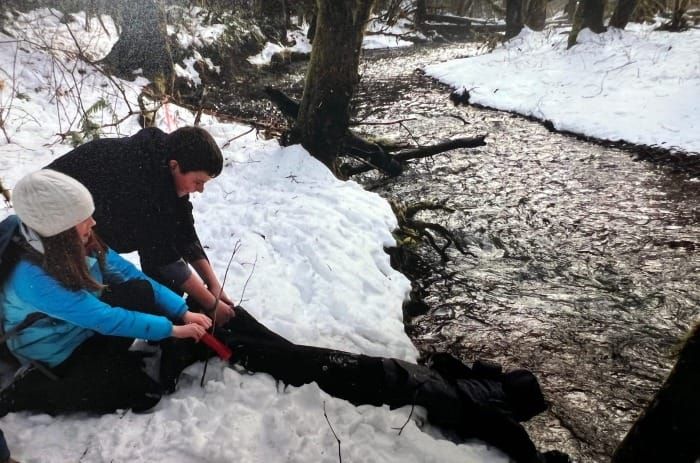
Water – Because water is to the land what blood is to the body, the study of forest waters helps us understand the forest’s condition. We’re fortunate to have springs and creeks of varying character and size flowing through each of our forests, from tiny seeps to powerful creeks. Of the many traits of water that can be measured, one of the simplest is also the most revealing and important – water temperature. Working in partnership with Oregon’s Department of Environmental Quality, each year we submerge data loggers at key locations in the forest creeks. Placed each spring and retrieved ahead of winter rains, these black, cigar shaped loggers reliably take and store readings every thirty minutes.
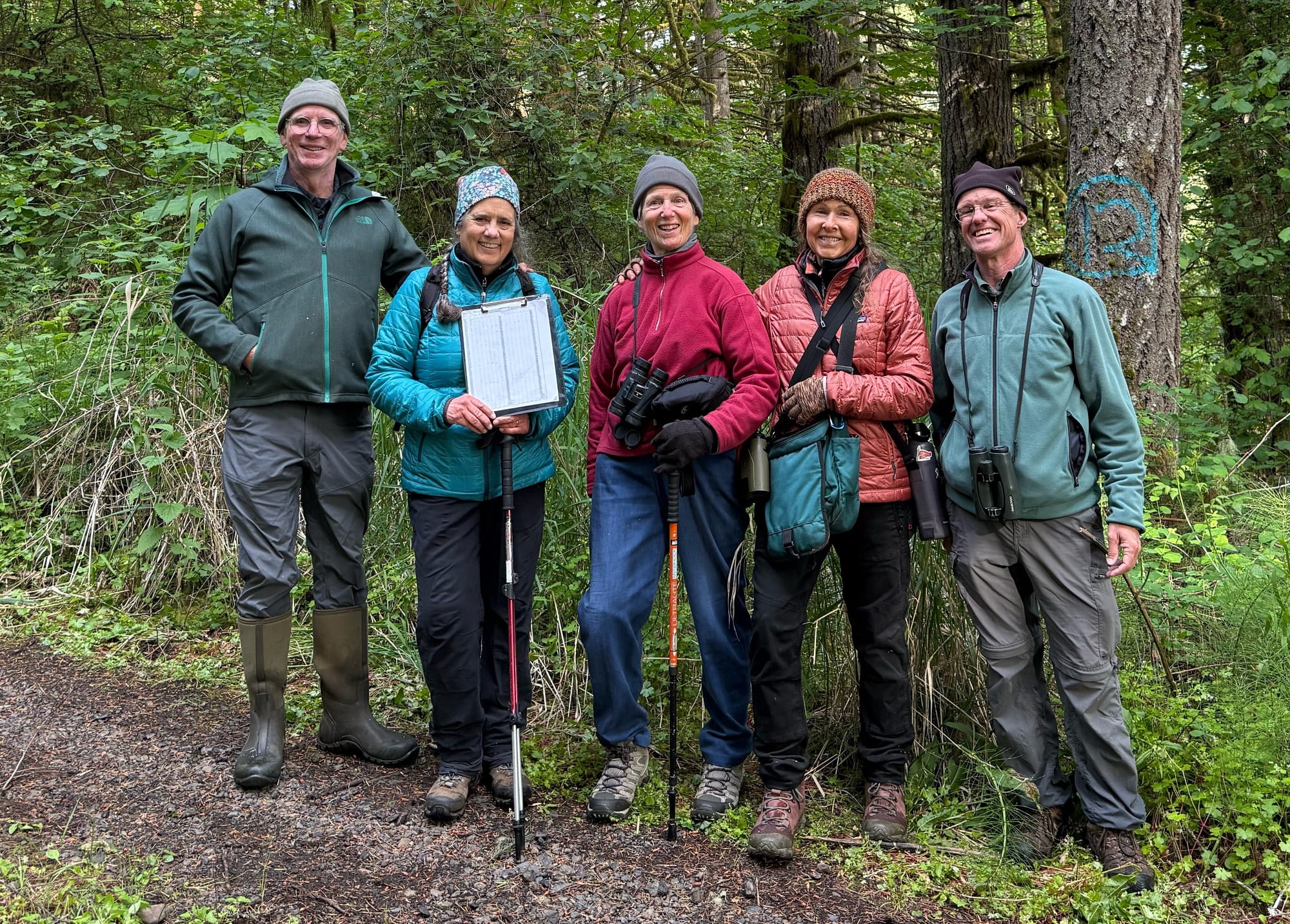
For the Birds – Above the sounds of burbling creeks we hear the calls and songs of early rising birds. During this busy and noisy time of spring migration, they have much to say. Over the past thirty years our annual inventories of birds provide reliable and inspiring indicators of the ever changing status and trends in both the forests and the bird populations. With its “quick three beers” call the Olive sided flycatcher sings the praises of the young, open areas, while the distinctive drumming of the Pileated woodpecker or the high call of the Brown creeper show that lovers of older forests have found a safe home. The encouraging commitment of expert birders is an essential ingredient and, year after year, we walk the set routes and stop at set locations for three minute point counts along the roughly three mile route, listening and taking stock. Timed to track the northly migration of neotropical migrants over a five week window, every year is different and inspiring. Though forsaking a cozy bed for the five AM start can be rough, year after year we’re reliably uplifted by the songs and calls enlivening the spring forest at in the early hours of spring days.
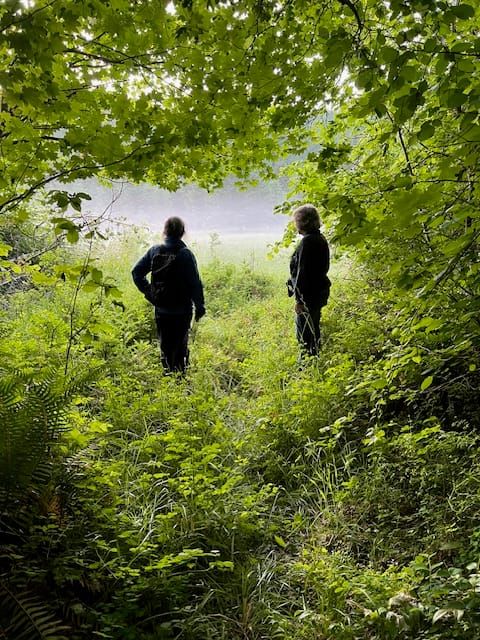
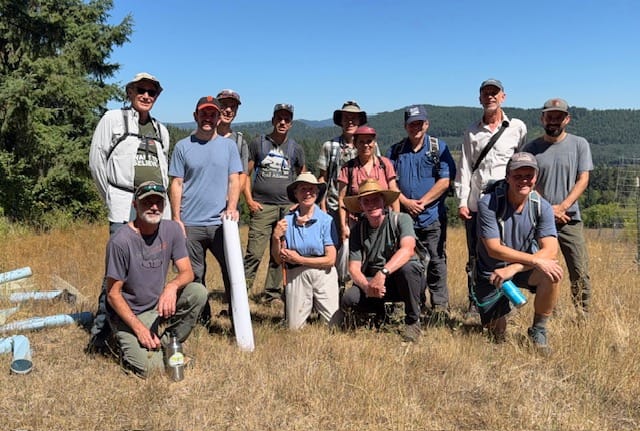
The Circle of Springs – In spite of our pledge not to succumb to the temptation of “any new ideas or projects”, sometimes we just can’t resist. Driven by gratitude for the forests’ many year around springs, twelve of them circling our Mt. Richmond Forest, and curious about how they are doing in increasingly hot and dry summer, on one of last August’s hottest days, twelve of us set out to visit and document the springs’ status. What might we learn from them during their season of greatest stress? Not long after my wife reasonably asked “so makes you think that anyone will be crazy enough to join you?”, she couldn’t resist signing on since the list of takers was so interesting and eclectic. With determined effort, we made it around the five mile loop just as the thermometer rose to triple digits. Climbing into their cars to leave, helpers called back “keep me on the list for next year!”.
A question that you might reasonably ask is “so, what have you learned from bearing witness?”. The answers to this question are both complex and simple. Because the complexity comes from rounding up the time and expertise needed to responsibly analyze the data, I will resist digging into answering that until some later date – and until we’ve gotten better at data analysis! The simple lesson that we continually learn is that the choice to invest in bearing witness is valuable, reliably interesting, and fundamental to our work as forest stewards. The uplift provided is an essential and welcome antidote to the weight we bear as determined citizens finding our way and caring for land through these tough times.
Thank you for reading and for considering these words; they spring from my commitment to doing my best to bear witness by chronicling these times and events. Until next time!
"Our endless and proper work is to pay attention." - Mary Oliver